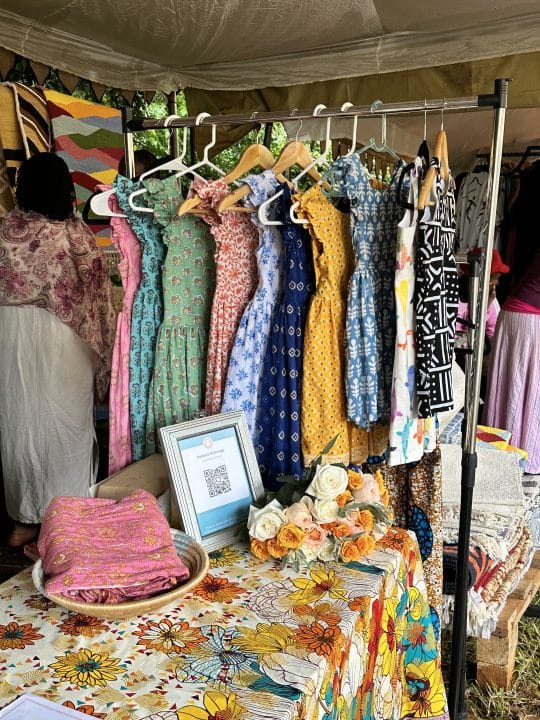
I started Pockets of Orange when my family and I were living in Nairobi, Kenya. At the time, we were in a season of life where I could afford help with the children and household tasks. For the first time in a long while, I had space. Time that belonged to me. Time to create.
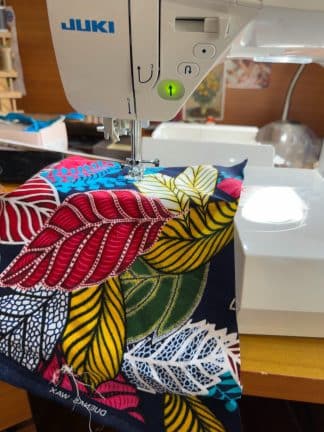 I had always loved the idea of making my own clothes, and clothing for my children. I remember wandering through stores like Target or Carter’s, searching for pieces that had some soul, something with character. What I usually found instead were racks of sameness. Children’s clothing dominated by the latest cartoon franchise, girls’ sections drowning in pinks and purples, boys’ sections stripped of imagination and limited to the safest reds, greens, and blues. It all felt uninspired.
Meanwhile, I was living in a place where color and pattern were everywhere. The local fabric markets were overflowing with bold, intricate, almost fantastical designs. The contrast was impossible to ignore. I remember thinking, I can make something better than this. Something joyful. Something alive. Something that felt like childhood should feel.
It was the African prints of the Kitenge in Kenya that made creating so much fun for me. African prints are so evocative and alive. There’s rarely an issue of them being too drab or boring. Each print is a celebration of funky colors and patterns. I also love how regions of Africa will have its signature pattern or how the fabric is used.
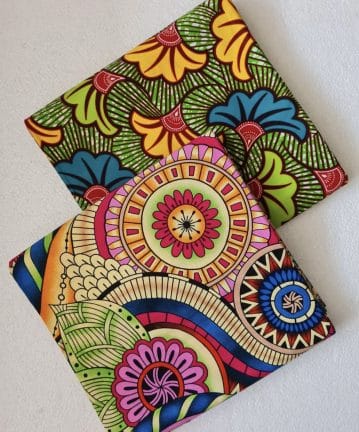
Kitenge is the common term for fabrics that hail from Kenya,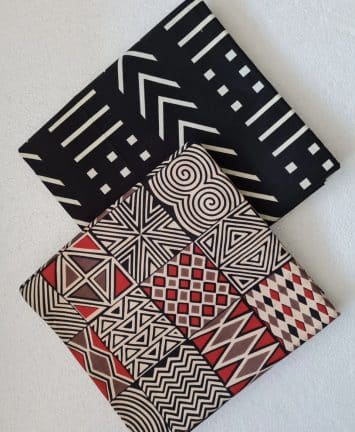 Tanzania, Uganda and much of East Africa. Ankara is usually associated with countries in West Africa like Nigeria, Ghana, and Côte d’Ivoire. Shweshwe is the name for the fabrics that come out of South Africa, and Chitenge is usually from Zambia, Malawi, Zimbabwe and other countries in southern African. Ankara actually uses a different printing process (wax-resist) than what’s used for Kitenge, Chitenge, and even Shweshwe. It’s not uncommon, however, for the term Ankara to be a catch-all name for all the prints that come from the continent.
I primarily use Kitenge and a bit of Shweshwe for the pieces I make that have African prints. It’s what I had access to in my travels, but I have a great fondness for all of them. I was a little disappointed to learn, however, that much of the Ankara and Kitenge is actually made in Europe or even China and India. African textile companies exist, but they are struggling to compete with the cheaper imports. Nevertheless, these fabrics have become very much a part of the culture in their respective countries and their beauty and fantastic designs deserve to be shown off.
At the time, I owned a modest computerized Singer sewing machine I had bought from Michaels for around two hundred dollars. Nothing fancy. Just enough to get started. I thought, why not try?
Sewing wasn’t new to me, even if it had been dormant for a while. My mother, grandmother, and my Auntie Sandy had all tried, at various points, to teach me how to sew. Auntie Sandy, in particular, was a gifted sewist, doll maker, and all-around creative force in our hometown of Columbia, South Carolina. She had been trying to get me behind a sewing machine for years. She even bought me my very first sewing kit: large fabric shears with teal-green plastic handles, a smaller pair of thread snippers, a seam ripper, and a ruler.
I remember working with her downstairs in her workshop when I was preparing to travel to Guyana, South America, with the Peace Corps. I wanted to make my own pants and clothing for the trip. I brought her a pair of pants I loved, and she showed me how to turn them into a pattern. That time, learning side by side, remains one of my most treasured memories. Auntie Sandy has since transitioned, but sewing with her still lives with me. The joy of it. The patience. The quiet confidence she carried into her work.
Although sewing was something I loved, I knew I needed a refresher. So in Nairobi, I joined a beginner sewing class a friend was hosting in her “she-shed” just outside her home in Runda. It was exactly what I needed. I quickly found my rhythm again, and before long I was making pants, skirts, and other pieces for Rose, our nanny and house help. Each project built confidence, curiosity, and momentum.
And that was the beginning. Not just of sewing again, but of Pockets of Orange.
If you’re interested in these fabrics here are some textile companies actually based in African countries: